Treating Grain Settlements as More Than a Deposit
How do you record a settlement in your accounting ledger?
What I generally see is the net deposit recorded as grain sales. If the elevator sends a check for $49,000, the farmer records $49,000 of income. The bank account reconciles, the deposit is accounted for, and everyone moves on.
That may be enough to file your tax return but within the settlement document for that check are valuable insights into your operation that the elevator (or ethanol plant or packer) is providing you that could increase your bottom line. Recording the information from settlements – not just the deposit – in your ledger is a great step towards using your accounting information to manage your business.
Start with bushels and price
The two most important pieces of information on the settlement are the bushels sold and the price received. Most accounting systems are better at tracking dollars than bushels. You may need to retain the quantity information through transaction descriptions, tracking categories, grain software, or a supporting spreadsheet. The specific system is up to you but consistently recording the information is the important part.
Having that information readily available allows you to:
Compare the settlement with your scale tickets, delivery records, grain contracts, and inventory records.
Did the elevator credit you for every load? Were the bushels applied to the correct contract? Did you receive the contract price?
Compare the price with your budget and cost-of-production breakeven.
Receiving a good contract price does not necessarily mean you received a good net return. Drying, storage, freight, and quality discounts can quickly reduce the value of that sale.
Record the selling costs
A grain settlement may include checkoff assessments, drying, storage, freight, moisture discounts, damage, foreign material, and other quality adjustments. These costs often disappear when only the net deposit is recorded.
Consider a settlement showing $50,000 of gross corn sales, less a $50 checkoff, $600 of drying, and $350 of quality discounts. The net deposit is $49,000. The simplified entry is:
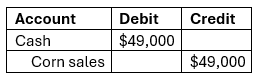
The entry reconciles the bank, but it hides $1,000 of selling costs and understates gross grain sales. A managerial entry provides more information: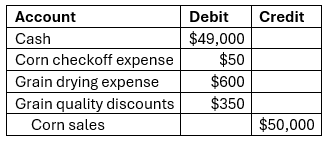
Both entries arrive at the same deposit but the second entry tells you how you got there. Livestock settlements have the same concept as grain settlements though the verbiage and charges are a little different.
Separate accounts allow you to calculate these costs per bushel and compare them between years, fields, hybrids, bins, and delivery locations. You may discover that one field and/or bin consistently produces higher drying or quality deductions. Seeing the dollars the issue is costing you may help you determine where to invest your money for a better return on investment.
Not every deduction is an expense
Some settlements include CCC loan repayments or payments made directly to lenders, landlords, input suppliers, or other lienholders. These should not automatically be recorded as grain-selling expenses.
If you have CCC loans, they should be on reported your balance sheet (here is an earlier article that I wrote on them with some particulars). Since CCC loan repayments are generally deducted directly from the sale by the elevator, the principal portion reduces the loan liability and the interest portion is deducted on your expenses.
The key is to determine what each item represents instead of posting everything to miscellaneous expense. Unusual items should be discussed with and reviewed by your tax preparer and/or accountant.
Use the information you already have
For each settlement, record the gross proceeds, identify the individual deductions, and reconcile the result to the bank deposit. Retain the settlement, contract, scale tickets, and delivery records as support with whatever recordkeeping works best for your operation.
At year-end, compare gross price, net price, and selling costs per bushel with your budget, breakeven, and prior years. The value of the information will increase as you have more years of comparison to see trends.
Utilizing your grain settlements with your accounting system can help you objectively look at your operation to help you determine where you should be invest your time, energy, and money. Like everything, you want to have a systematic process for recording the transactions that will best help you.
