Now that we are getting into tax planning season, we are coming to the age-old question: should I go get that new piece of equipment to lower my taxes? This is a debate that has been going on between tax advisors, farmers, and bankers since the beginning of time (well, probably since the income tax was started). There are a lot of considerations but usually the first three questions are:
· Can I afford it?
· What is the tax deduction?
· What does the financing look like?
Assume a farmer purchases $300,000 of new qualifying equipment on December 15, 2026, pays $60,000 down, and finances the remaining $240,000 over five years. The payment schedule below shows annual debt service of $59,424, paid in semiannual installments beginning in 2027.
Let’s compare three depreciation approaches: five-year straight-line, regular accelerated MACRS, and 100% bonus depreciation. Assume the equipment qualifies for five-year treatment, the half-year convention applies, and all deductions can be used when generated. The straight-line comparison assumes an available election; regular MACRS uses 200% declining balance. These assumptions are important and we’ll get into why at the end.
The table includes both depreciation and loan interest in the tax-deduction columns. Cash outflows are shown as positive amounts.
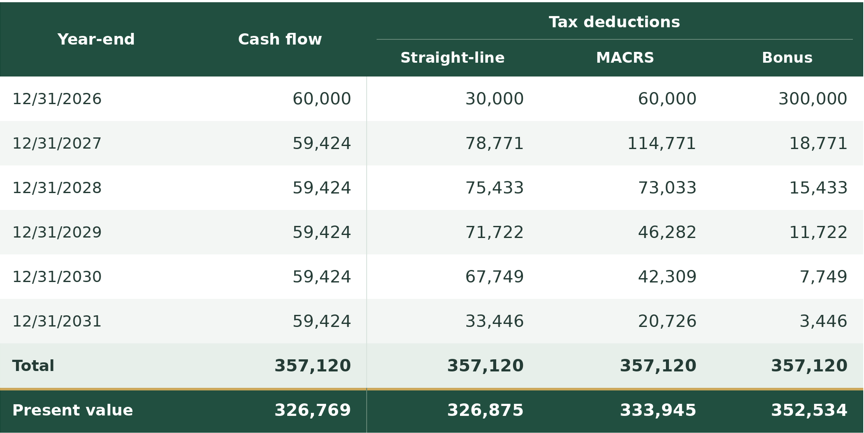
I’m going to use present value to compare the timing. Earlier deductions receive greater weight because a dollar of tax savings today is generally worth more than the same dollar received later. Also, the assumed 3.75% inflation rate is meant to illustrate purchasing-power differences. It does not fully reflect borrowing costs, alternative investments, or risk.
So what does the analysis show us:
Each method provides the same total deductions: $300,000 of equipment cost plus $57,120.30 of interest.
All the tax deduction methods have higher present values than the scheduled loan payments.
Bonus depreciation has the highest present value because it front loads the deduction, while straight-line has the lowest.
Other than the first year in MACRS, none of the deductions match the cashflow
Straight-line deductions exceed loan payments in four of six years.
MACRS = two of six years
Bonus = in one of six years.
The MACRS deduction happens to equal the down payment. Both are 20% of the purchase price under these assumptions, but depreciation follows the equipment’s basis and applicable tax rules, regardless of financing.
Mid-quarter convention would only allow 5% deduction in 2026
One important thing to consider is that the present value of deductions is not the present value of tax savings. Ultimately, it is the effect on taxable income as a whole - not just as a single transaction - that really determines the benefit. I’ll follow up with a post using this same example to show how tax rates and the timing of deductions affect taxable income.
Going back to the assumptions; equipment purchases are not always straight-forward for deductions. Circumstances of your tax return can change what deductions are available to you. Is half-year convention available? Is the equipment five-year or seven-year? Discuss the purchase and depreciation options with your tax advisor during year-end planning—ideally before committing to the purchase, while you still have time to change the outcome.
The moral of the story is the equipment should improve the operation, the financing should fit its cash flow, and the depreciation decision should support both.
